Español
 Francés
 Русский
 Português
 Deutsch
 Italiano
 العربية
 Magyar
 Română
 Filipino
 日本語
日本語
 한국어
한국어
 Việt
Việt
 Nederlands
Learn About The Working Principle And Application Of Oral Scanners
How does an intraoral scanner work?
Thousands of images are captured by imaging sensors when the handheld, pen-like scanner is placed inside a patient’s mouth, and a light source projected onto the area you wish to scan.
Those images are processed by scanning software, which then generates an accurate 3D surface model showing the teeth and gingiva’s geometry. This 3D model is displayed on your PC screen, and you can see it being generated as you are scanning.
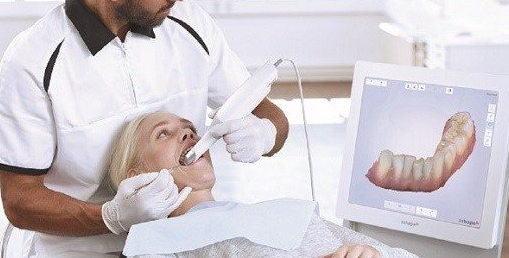
CAD, not fad: Decades of technological advances in Computer-Aided Design/Manufacturing offer clinics advanced 3D models.
Digital mouth scanning might be new to a majority of dental clinics, but the technology itself is tried and tested.lsidora Christopoulou et al., in their paper "Orthodontic Intraoral Scanners: A Critical Review, state that"digital technology has entered the dental and orthodontic clinics with the introduction of computer-aided design/computer-aided manufacturing(CAD/CAM).
It was shown how digital inventions, such as the 3D dental scan machine, have introduced the digital era in dentistry, and that “intraoral scanners constitute a significant chapter in this evolution, with a very promising future ahead.”
According to the FDI World Dental Federation, everyday dental practice is, or soon will be, affected by the use of Dentists and laboratory technicians use new tools developed for digital impressions, computer-aided design, and fabrication with subtractive or additive manufacturing (such as laser sintering and 3D printing including stereolithography), all of which require good practice procedures to ensure the quality of the final product.
“The use of digital impressions eliminates a number of clinical and laboratory steps, leading to fast and effective delivery of the final custom-made medical device.”
What’s more accurate – analog or digital impressions?
Digital impressions and dental 3d imaging software might be fast and eliminate some of the steps found in analog impression taking, but what about intraoral scanner accuracy?
It should be noted that eliminating steps in the process itself aids accuracy, as the more steps required the more likely it is to inadvertently introduce human error or material flaws. Digital scan quality is itself measured in terms of accuracy. We’ve outlined what exactly accuracy is and how it affects your treatments on our blog.
Today, intraoral scanner accuracy is equal to, if not better than, results from analog impressions. And there is extensive clinical research in this area that highlights this. Learning how to interpret accuracy data in clinical studies is key when you want to assess which scanner is best for your purposes.
In Digital Versus Conventional Impressions in Dentistry: A Systematic Review, Chandran et al. 2019, found that 67% of (16 of 24) studies showed that digital impressions from dental digital impression scanners are more accurate (in microns) when compared to conventional impression taking, with 92% of (22 of 24) studies show the same level of clinical acceptability as conventional.
The Journal of Clinical & Diagnostic Research review summarized that digital impressions are superior to conventional impressions, without any statistically significant difference, based on assessment of accuracy, patient preference and operator
In addition, Dr. Vincent Prestipino, Prosthodontist, told us, “The curtain that doctors have been hiding behind: the one that says digital is no good or the quality isn’t there, no longer exists.”
One of the big steps in going digital is choosing the right intraoral scanner technology for your clinic and your particular professional needs, whether it is simply for digitizing your lab workflow or taking a digital scan for dentures to digitize your denture workflow.
Over 10 years ago, the Institute of Digital Dentistry started making the transformation to digital dentistry in its clinics. “Today, all our clinics are equipped with dental digital impression scanners and CAD/CAM technology, and we strongly believe that going digital will completely transform your practice and make dentistry much more enjoyable for both you and your patients,” said Dr. Ahmad Al-Hassiny, director of the institute.